
The Tyranny of the Great White Page: Writing Beyond the Edge
The Tranny of the Great White Page:
Writing Beyond the Edge
By: Ann Dale
The Tranny of the Great White Page:
Writing Beyond the Edge
Many writers face the tyranny of the blank page, but we write because we believe our words can matter. Beyond the Edge emerged from that belief as a response to the climate and biodiversity crises that shape our world today.
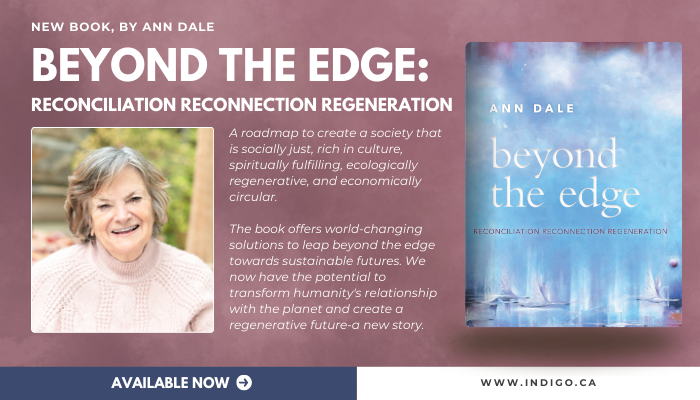
Many writers face the tyranny of the great white page when you begin a new book, a new article, or sometimes even a blog. Then why do we write? We believe we have something important to communicate and hence my new book, Beyond the Edge: Reconciliation, (Re)Connection and Regeneration was started, to try and make a difference to the climate and biodiversity crises. I originally thought I would just revise my earlier book, Edging Forward and once I began, quickly realized I had to update all the stats and then began to rewrite many of the chapters, believing I had to communicate the numerous solutions for responding to the planet through reconciliation, reconnecting and regeneration.
Still believing how the stories we tell ourselves, and are told, influence our agency to believe we can make a difference, every chapter describes solutions, individually and collectively, that we can make to change our current life destroying pathways. In addition, the book contains the wonderful original landscape paintings my collaborator, Nancyanne Cowell made illustrating each chapter. Why? Because we believed that integrating art, beauty and research will lead to greater action, engaging both the heart and the mind.
Since 1995, my colleague John Robinson and I have argued that we have enough information, enough science and knowledge to respond to our modern challenges and I am more convinced than ever, that it is now a question of political will and each of us to make a difference now. It is up to us to convince our political leaders that they must act now and urgently before it becomes too late in the following decade. This book, based on 25 years of research, is my plea to each of us to change our current pathways and leap to more regenerative communities everywhere in Canada.
Purchase your copy of Beyond the Edge as a hardcover or e-book today! Available exclusively in store and online at Indigo!
Kirkus Reviews: “A provocative, informed, and compelling brief for the protection of a beautiful, imperiled world.”
“Time for Canadians to get serious about decarbonization and protecting biodiversity, according to this luminous eco-manifesto.
Dale, a professor emerita at Royal Roads University, warns that urgent action is needed to avoid irremediable harms from global warming and species loss. She suggests that the Canadian government set wildly ambitious goals, including achieving carbon neutrality by 2030, ending all government support for fossil fuel production, and devoting half the country’s land to biodiversity protection. Individuals should do their part too, she continues, by planting lawns with indigenous plants, shopping at farmers markets, and cutting back on meat. Her ideas open out into a wider progressive vision of economic and social sustainability and equality: Society should aim for “degrowth” that steadily lightens consumption’s burden on the land; the wealth of the rich should be redistributed through high taxes; the government should guarantee everyone a basic income to cushion people against the economic disruptions of decarbonization and ensure material sufficiency for all. A major theme here is the need for better messaging to combat climate denialism and complacency and convince people to act, which she provides through a lucid, fact-filled tour of scholarship on everything from planetary limits to housing costs. Dale’s prose is limpid and down-to-earth, emphasizing practicalities while adding evocative grace notes that bring eco-consciousness to life. (“After a rainfall, take the time to move the live worm from the pavement to the grass. Add refuse to the first of the 4 Rs, recognizing the power of your consumption choices. Speak up when you see something unsustainable at your local neighbourhood store. Talk to the manager about more regenerative options, ask about more sustainable choices, and keep speaking up and out.”) The book is illustrated with color reproductions of painter Nancyanne Cowell’s landscapes, which feature still waters beneath fluttering birds and undulant mists, backgrounded by green forests or city sunsets; these images provide a haunting visual accompaniment to Dale’s reflections.
A provocative, informed, and compelling brief for the protection of a beautiful, imperiled world.” – Kirkus Reviews